


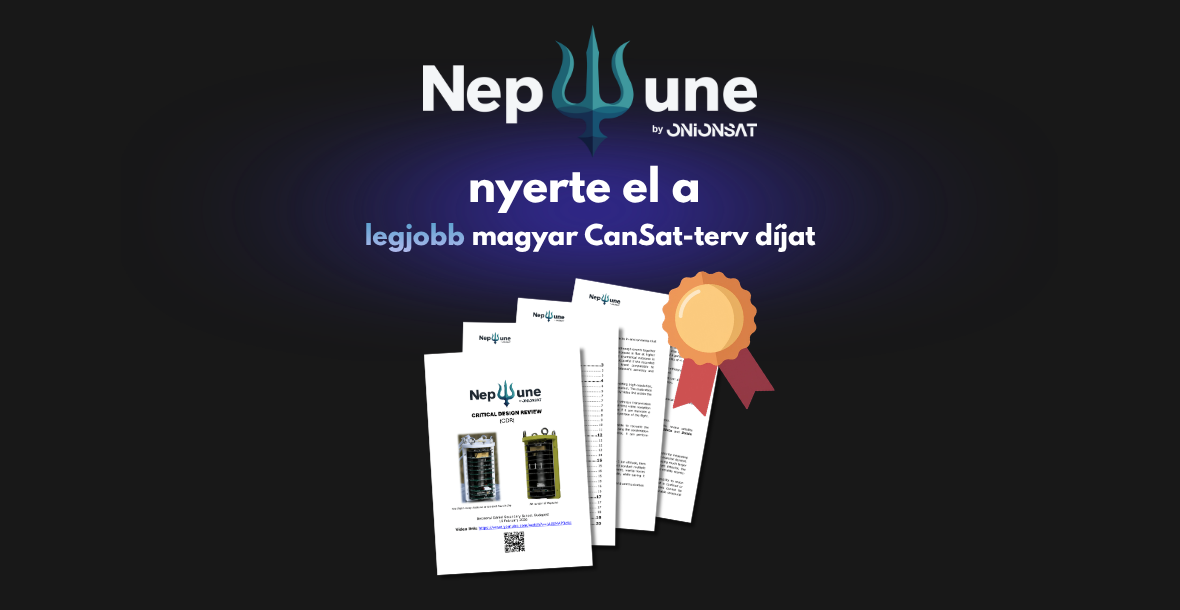
Award-winning project

We deliver the future.
Meet our CanSat satellites,
és unique radiation physics experiments.
CanSat

Neptune our latest satellite that was made for the 2026 CanSat competition, which was designed with modularity in mind, with the goal to upgrade it in the future.

Expandability and flexibility
The satellite is made up of 13 panels of identical geometry, which can be interchanged at any time, ensuring easy assembly and allowing for future developments.

Muon flux detection
The secondary mission of the satellite is to determine the muon flux using a plastic scintillator and a silicon photomultiplier, which are detected by a peak detector circuit.

Live camera feed
A 5 megapixel camera is mounted on the satellite, which streams the captured image live and can capture high quality photos remotely, which can be either stored on an SD card or transmitted via radio.

Redundant system
The primary mission of the satellite is redundantly designed. The primary mission is performed with quadruple redundancy and an additional 4 sensors can be remotely enabled as a cold backup in case of a sensor failure.

Multichannel communication
The satellite communicates in the 868 MHz ISM frequency band with LoRa modulation, and is also able to communicate with the ground station via the LTE mobile network, which can be useful during recovery operations.

Remote control
The satellite is fitted with sensors to measure power consumption, and it is optionally possible to switch on and off the individual sub-units from the ground station in the event of an anomaly or simply to save energy.
Space industry
Projects
CanSats and satellites for the future

Cosmic radiation measurement
Hunity
We have developed a unique gamma-ray measurement module on board the Hunity satellite, which uses a special liquid to measure the absorbed radiation dose.

Muon counting
Project Gaia
Our team's second CanSat satellite was a higher-tech project with two secondary experiments. On board was a muon counting device and a camera, and the primary mission was designed to be fully redundant.
Muon counting
Project Gaia
Our team's second CanSat satellite was a higher-tech project with two secondary experiments. On board was a muon counting device and a camera, and the primary mission was designed to be fully redundant.

Wind gust monitoring
Project Onion
The main profile of our team's first CanSat satellite was wind gust monitoring. It was built for the 2024 national CanSat competition, where it won a technological special prize.
Blog
Follow the progress of our project, and learn how our innovative CanSats are made!



Got a good idea?
If you have an idea you'd like to share with us, don't hesitate!
Contact us by clicking the button below.